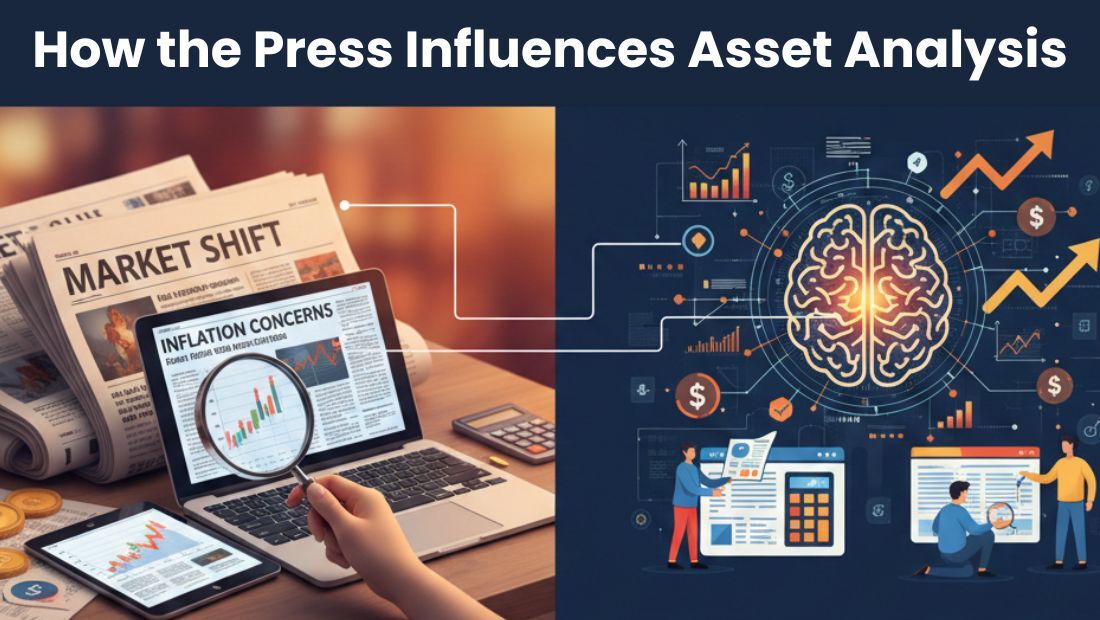
In today’s fast-moving financial markets, investors are exposed to an overwhelming volume of news, opinions, and speculation. Financial media plays a critical role in shaping market sentiment, but not all information carries the same weight. The real challenge for investors and analysts is learning how to distinguish useful financial information from market noise.
Understanding how the press affects asset prices, investor behavior, and market volatility is essential for building consistent and profitable investment strategies. While high-quality journalism can support informed decision-making, sensationalist headlines and rumor-driven reporting often distort short-term prices without changing long-term fundamentals.
This article explores the ambiguous role of the press in asset analysis, the difference between noise and meaningful signals, key metrics used to assess media impact, and best practices to filter information effectively.
The Dual Role of the Financial Press
The financial press serves a complex and sometimes contradictory function in the investment ecosystem. On one hand, it provides access to earnings reports, economic indicators, corporate announcements, and expert analysis that are essential for valuation and portfolio management. On the other hand, it can amplify speculation, exaggerate risks, and create emotional reactions among investors.
›SEE MORE DETAILSMarket noise refers to short-term price fluctuations caused by headlines, opinions, or rumors that do not materially affect an asset’s intrinsic value. Useful information, in contrast, is grounded in data, verified sources, and long-term relevance.
The challenge arises because both types of content often appear side by side. A dramatic headline may trigger a sharp intraday move, while a less visible earnings detail may have a far greater impact on long-term performance.
Noise vs. Useful Information in Asset Analysis
Not all news deserves the same analytical attention. Studies suggest that only 1–2% of daily financial news remains relevant after one year, highlighting how much content loses significance over time.
Key characteristics of market noise include:
- Emotional or sensational language
- Focus on short-term price movements
- Heavy reliance on anonymous sources or speculation
- Lack of supporting data or financial context
In contrast, useful financial information typically shows:
- Verified sources and official disclosures
- Consistency over time rather than isolated mentions
- Clear links to fundamentals such as revenue, cash flow, debt, or macroeconomic trends
- Strategic relevance for medium- and long-term investors
Recognizing this distinction helps investors avoid overreacting to headlines and improves the quality of asset valuation and risk assessment.
How Media Coverage Affects Market Behavior
Media influence on financial markets is measurable. In some cases, major indices can fluctuate significantly during a single trading session without any change in underlying fundamentals. For example, the Ibovespa or other major stock indices may swing up to 1% purely due to news sentiment, not structural developments.
This phenomenon is closely linked to behavioral finance. Investors exposed to alarmist or overly optimistic coverage may act impulsively, leading to herd behavior and excessive volatility.
Short-term traders may exploit this volatility, but long-term investors risk making suboptimal decisions if they confuse media-driven movements with genuine changes in asset value.
Metrics Used to Measure Media Impact on Assets
Professional analysts use specific metrics to evaluate whether media coverage is influencing an asset in a meaningful way. Common indicators include:
- Reach and impressions: Measures how widely the news has been distributed
- Media quality: Assesses the credibility, reputation, and specialization of the source
- Sentiment analysis: Evaluates whether coverage is positive, negative, or neutral
- Engagement levels: Tracks discussions, shares, and reactions on social media and financial forums
- Frequency and persistence: Determines whether the topic appears consistently or only briefly
These metrics help analysts separate temporary sentiment shifts from information that may affect valuation models, earnings expectations, or risk premiums.
Information Overload and Its Risks
The digital transformation of media has replaced the traditional “one-to-many” communication model with an “everyone-to-everyone” environment. News spreads instantly across platforms, often without proper verification.
This information overload increases the risk of:
- Impulsive trading decisions
- Overtrading and excessive transaction costs
- Misinterpretation of rumors as facts
- Emotional bias overriding rational analysis
Investors who react to every headline often miss medium- and long-term opportunities that require patience and strategic focus.
Tools and Best Practices to Filter Market Noise
To protect investment strategies from media distortion, it is essential to adopt disciplined filtering practices and analytical tools.
Effective approaches include:
- Source evaluation: Prioritize specialized financial media, official filings, and regulatory announcements
- Cross-verification: Compare news across multiple reliable sources
- Fundamental alignment: Check whether the news affects revenue, margins, debt, or growth prospects
- Analytical platforms: Use tools that track keyword frequency, sentiment, and historical impact
- Time horizon discipline: Avoid making portfolio decisions based solely on daily headlines
Developing a medium- to long-term investment perspective reduces sensitivity to noise and improves consistency in portfolio performance.
The Press as Both Risk and Opportunity
Despite its risks, the press remains a powerful analytical resource when used correctly. High-quality investigative journalism, macroeconomic reporting, and expert commentary often highlight trends before they are fully priced into the market.
For disciplined investors, media analysis can complement traditional fundamental analysis, technical indicators, and macroeconomic research. The key lies in critical reading and structured interpretation.
Final Thoughts
The influence of the press on asset analysis is inherently ambiguous. It can either enhance investment decision-making or create costly distractions. The difference lies in the investor’s ability to separate meaningful signals from market noise.
By applying impact metrics, verifying sources, and maintaining a clear investment horizon, investors can reduce emotional bias and improve risk-adjusted returns. In an increasingly interconnected and media-saturated market, mastering information filtering is no longer optional—it is a core competency for financial success.
